Online Shopping Rights: Returns, Refunds and the 14-Day Rule
In the EU and UK you can cancel most online purchases within 14 days of delivery and get a refund within 14 days, plus a legal guarantee for faulty goods. In the US there is no federal right to return: the store's policy, state law and your card's dispute rights decide.
FeedbackPlatform editorial teamNovember 25, 2026 10 min read
If you buy online from a business in the EU or the UK, you can cancel within 14 days of delivery without giving a reason and get your money back within 14 days. On top of that you have strong legal rights if the item is faulty. In the US there is no general legal right to return: the store's return policy, a few state laws and your credit card's dispute rights do the work.
In short
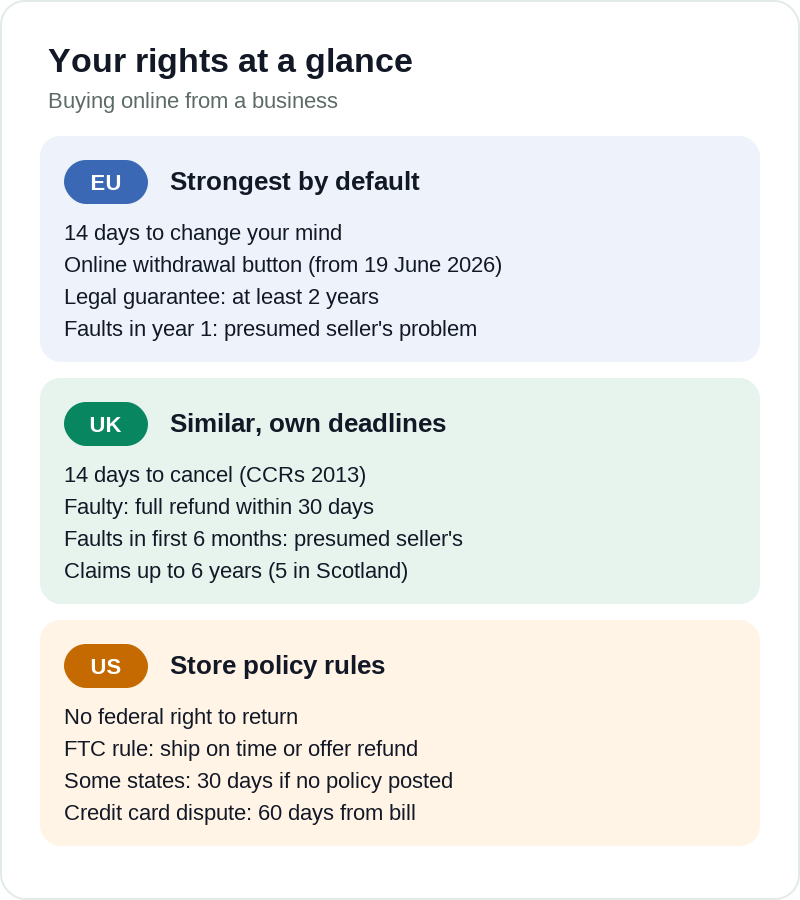
EU and UK: 14 days after delivery to cancel most online orders, then 14 days to send the item back. Refund within 14 days, including standard delivery.
EU withdrawal button: since 19 June 2026, online stores selling to EU consumers must offer a clear "withdraw from contract" function.
Faulty goods: EU legal guarantee of at least 2 years (Your Europe). UK: full refund within 30 days, and up to 6 years to claim.
US: no federal return right. The FTC Mail Order Rule covers late or unshipped orders, some states require a posted policy, and credit cards let you dispute charges within 60 days of the bill.
When a store says no: put it in writing, then use a chargeback, Section 75 (UK), PayPal Buyer Protection or a consumer body.
What are your online shopping rights in each region?
Your rights depend on where you live and where the seller is based. EU and UK law gives you a cooling-off period and a legal guarantee no matter what the store's policy says. US law mainly protects you against non-delivery and unfair billing.
The short version: EU and UK law sets minimums, in the US the store policy rules
EU
UK
US
Change-of-mind returns
14 days from delivery
14 days from delivery
Only if store policy allows
Time to send it back
14 days after cancelling
14 days after cancelling
Store policy
Refund deadline
14 days
14 days
Store policy; 7 working days for unshipped orders (FTC)
Return shipping
You pay, if told in advance
You pay, if told in advance
Store policy
Faulty goods
Legal guarantee, min. 2 years
30-day right to reject, claims up to 6 years
Implied warranty under state law
Who proves the fault?
Seller, in year 1
Seller, in first 6 months
You
Card protection
Chargeback (scheme rules)
Section 75 + chargeback
Fair Credit Billing Act
How does the 14-day return rule work in the EU?
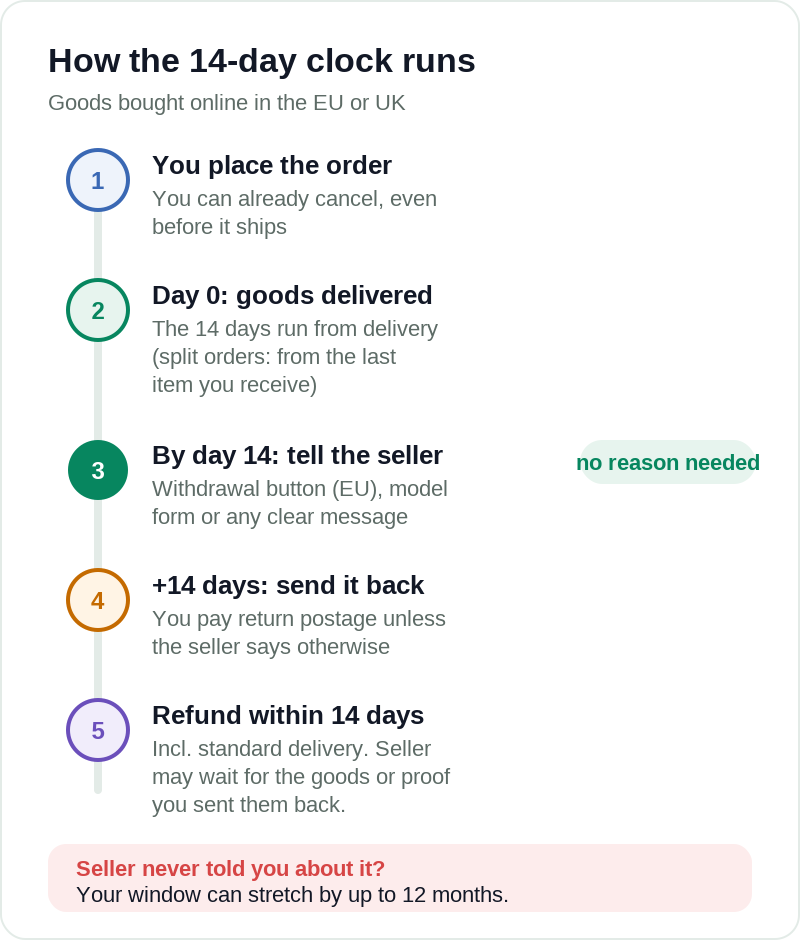
In every EU country, you can withdraw from an online or distance purchase from a business within 14 days without a reason. For goods, the clock runs from the day you receive them. If an order arrives in parts, it runs from the last part.
The steps are simple:
Tell the seller within 14 days. Use the withdrawal button, the model withdrawal form the seller must provide, or any clear email.
Send the goods back within 14 days of telling them.
Get your refund within 14 days of your withdrawal. The seller may wait until the goods arrive or you show proof of sending.
The refund includes the standard outbound delivery cost. If you paid extra for express delivery, you only get the standard rate back. If the seller never told you about your right to withdraw, your window extends by up to 12 months.
How the 14-day clock runs in the EU and UK
The new EU withdrawal button
Since 19 June 2026, online traders selling to EU consumers must offer an online withdrawal function. It comes from Directive (EU) 2023/2673, which added a new Article 11a to the Consumer Rights Directive.
What it means for you:
A clearly labeled button such as "withdraw from contract here" must be easy to find for the whole withdrawal period.
You enter only basic details (name, order number, which item) and confirm with a second button.
The seller must send an acknowledgment, for example by email, with the date and time of your request.
You don't need to create an account.
Online stores outside the EU that sell to EU consumers are covered too. The rule applies to the EU, not the UK.
What can't you return in the EU?
The main exceptions are custom-made or personalized goods, perishable items, sealed hygiene products and sealed audio, video or software once you have opened them, newspapers, items with prices tied to financial markets, and services booked for a specific date, such as event tickets, hotel stays and car rental. Digital downloads and streams lose the right once you start them, if you agreed to that beforehand.
What are your rights in the UK?
The UK kept rules very close to the EU's after Brexit, in two laws. The Consumer Contracts Regulations 2013 cover changing your mind. The Consumer Rights Act 2015 covers faulty goods and delivery.
You can cancel from the moment you order until 14 days after you receive the goods.
You then have another 14 days to send them back.
The seller must refund you within 14 days of receiving the goods, or of your proof of return, whichever is sooner.
Basic delivery is refunded; premium delivery upgrades are not.
If the trader didn't give you the required information, the period can extend by up to a year.
Exceptions match the EU list: tailor-made or personalized items, perishables, broken hygiene seals, unsealed CDs, DVDs and software, and date-specific services such as flights, hotels, car hire and event tickets.
Faulty goods: 30 days, 6 months, 6 years
Under the Consumer Rights Act, goods must be of satisfactory quality, fit for purpose and as described. If they aren't:
Within 30 days of delivery, you can reject them for a full refund.
From 30 days to 6 months, the retailer gets one chance to repair or replace. If that fails, you can ask for a refund, without deductions for use (cars excepted). A fault in these first 6 months is presumed to have been there from the start.
After 6 months, you have to show the fault was there when you got the item.
You can bring a claim for up to 6 years in England, Wales and Northern Ireland, and 5 years in Scotland.
What are your rights in the US?
There is no federal law that gives you a right to return something you simply don't want. A US store can sell everything as final sale, as long as it is honest about it. Your protection comes from four other places.
1. The FTC Mail, Internet, or Telephone Order Rule
The FTC rule covers orders that don't ship on time. A seller must ship within the time it advertised, or within 30 days if it gave no time. If it can't, it must tell you and let you choose between waiting and cancelling. If you cancel or the order never ships, the refund is due within 7 working days, or within one billing cycle when the seller extended credit. Store credit doesn't count as a refund.
The rule does not create a right to return goods that did arrive.
2. State laws on refund policies
Some states require stores to post their refund policy. In California, if a store doesn't clearly post a limited or no-refund policy, you can return items with proof of purchase within 30 days, according to the California Attorney General. New York's General Business Law § 218-a has a similar 30-day rule for unused items. These laws were written mainly with physical stores in mind, so check your own state's consumer protection office.
3. Implied warranties
Under state law based on the Uniform Commercial Code, goods sold by a merchant generally come with an implied warranty that they work as ordinary goods of that kind should. Sellers can limit this in some states with clear "as is" wording, so read the listing.
4. Your card and payment protections
The Fair Credit Billing Act lets you dispute credit card charges for goods that weren't delivered as agreed. Your letter must reach the card issuer within 60 days after the first bill with the charge was sent. PayPal Buyer Protection and marketplace programs like the Amazon A-to-z Guarantee add another layer.
A blender that won't blend
Jake in Ohio orders a $180 blender from an online store with a "30-day returns, buyer pays shipping" policy. On day 40 the motor dies. The return window is closed, but returns aren't the only route. He emails the seller that the product failed under normal use and asks for a repair or replacement under the warranty. The seller ignores him for two weeks. Because his card statement with the charge was sent only five weeks ago, Jake disputes it with his card issuer. He explains the item stopped working and attaches his emails. The issuer can now investigate and ask the seller to respond. A UK buyer in the same spot would have a stronger claim: the fault appeared within 6 months, so the retailer must repair or replace, or refund.
How do you get a refund when the store says no?
Escalate step by step, and keep everything in writing.
Write to the seller. Give your order number, what went wrong and what you want: refund, repair or replacement. In the EU and UK, name the law: "my right to cancel under the Consumer Contracts Regulations" or "the Consumer Rights Act 2015".
Set a deadline. Give 14 days and say what you'll do next. Which? and Citizens Advice have free template letters.
Use your payment protection.
Credit card (US): dispute within 60 days of the bill under the Fair Credit Billing Act.
Credit card (UK): Section 75 of the Consumer Credit Act makes the card company jointly liable for single items costing over £100 and up to £30,000.
Debit or credit card (chargeback): not a law but card scheme rules. Which? says claims are typically due within 120 days.
PayPal or marketplaces: open a case in the app before the deadline.
Use a consumer body. EU: the European Consumer Centre in your country (listed on Your Europe) for cross-border cases. UK: Citizens Advice, which can pass cases to Trading Standards. US: your state attorney general and ReportFraud.ftc.gov.
Small claims court is the last resort, and often cheaper than people think.
If the store has vanished, it isn't a returns problem
A shop that stops replying, has a disconnected phone number and a brand-new domain is probably a scam, not a slow refund department. Return rights won't help. Act fast on your payment instead: see scammed online: how to get your money back.
How can you protect yourself before you buy?
Most return fights can be avoided in two minutes before checkout.
Find the returns page. Look for the return window, who pays shipping and the return address. A return address on another continent can cost more than the item.
Check who the seller is. A real company name, address and registration number are a good sign. On marketplaces, check whether you're buying from the platform or from a third-party seller.
Pay with protection. A credit card or PayPal gives you options a bank transfer or gift card never will. See the safest way to pay online.
Screenshot the product page and policy. Policies change; your screenshot doesn't.
Read recent reviews for patterns like "never refunded" or "return address doesn't exist".
The free check below looks up company details, whether a returns policy can be found, payment methods and reviews in one go.
Is this website trustworthy?
Check any webshop for free: company details, reviews, payment safety and warning signs.
Checklist: the perfect return
Note the delivery date (day 0)
Cancel in writing or with the withdrawal button within 14 days (EU/UK) or within the store's window (US)
Save the confirmation email or a screenshot
Pack the item well, with all parts and accessories
Ship with tracking and keep the receipt
No refund within 14 days? Send a written demand, then go to your card issuer or PayPal
Your next step
Write down the delivery date of your latest order. That single date tells you how long you have. If the package never arrived at all, the rules are different: read package not delivered. Shopping on a big marketplace from overseas sellers? Our guide is Temu legit? explains how returns and refunds work there, and how to tell if a website is legit helps you spot a shop that will never refund anyone.
Frequently asked questions
Yes in the EU and the UK. EU consumer law and the UK Consumer Contracts Regulations 2013 give you 14 days after delivery to cancel most online orders from a business, without a reason. The US has no such federal law: returns depend on the retailer's policy and a few state rules.
In the EU and UK, not for a cancellation within the 14-day window: the seller must refund you using the same payment method unless you expressly agree to something else. In the US, a store can offer credit only if its posted policy says so. Under the FTC Mail Order Rule, an order that never ships must be refunded in money, not vouchers.
In the EU and UK you usually pay to send back an item you simply changed your mind about, but only if the seller told you so before you bought. If the item is faulty, the seller pays. In the US, return shipping is set by the store's policy.
In the EU and UK, 14 days. The clock starts when you cancel, but the seller may wait until it gets the goods back or you show proof you sent them, whichever comes first. In the US, if an order never shipped, the FTC rule requires a refund within 7 working days, or within one billing cycle for credit sales.
In the EU and UK, yes: discounted items bought online have the same 14-day cancellation right and the same protection if faulty. A store may refuse to exchange sale items bought in a physical shop because you changed your mind. In the US, 'final sale' items can be excluded if the policy says so.
No. Cancellation rights and legal guarantees only apply when you buy from a business. On eBay, Facebook Marketplace or Vinted you have them only if the seller is actually a trader. Platform protection programs may still help.
Is this website trustworthy?
Check any webshop for free: company details, reviews, payment safety and warning signs.
Read next
Your rights10 min read
Package Not Delivered but Says Delivered? What to Do Next
If tracking says delivered but you have no package, search nearby, wait up to 48 hours, then contact the seller, not just the carrier. The seller can replace or refund, and your card or PayPal is the backup. Here are the exact steps for USPS, UPS, FedEx, Amazon, Royal Mail and Evri.
Scams and fake shops12 min read
Is This Website Legit? 18 Checks to Spot a Scam Site in 2 Minutes
To tell if a website is legit, check who owns it (company registry), how old the domain is, whether Google flags it, what other people say, and whether you can pay with buyer protection. Here are 18 signals and a 2-minute routine you can run before every purchase.
Paying safely11 min read
Safest Way to Pay Online: Every Method Ranked by Protection
The safest way to pay online is a credit card, followed by PayPal (Goods and Services): both let you claw your money back if a seller doesn't deliver. Debit cards and buy now, pay later are middling. Bank transfers, Zelle, wires, crypto and gift cards offer almost no protection.