Is Temu Legit? Temu, Shein, AliExpress and Alibaba Checked (2026)
Yes, Temu, Shein, AliExpress and Alibaba are legitimate companies and most orders arrive. The real risks are unsafe products, uneven quality, new import costs and data collection. Here's what changed in 2026 and how to buy safely.
FeedbackPlatform editorial teamNovember 25, 2026 11 min read
Yes, Temu is legit: it's a real company, most orders arrive, and refunds generally work. The same goes for Shein, AliExpress and Alibaba. What isn't fine is product safety. Regulators and consumer groups keep finding unsafe toys, chargers and jewelry, and in 2026 the EU fined Temu and AliExpress a combined €750 million.
In short
Legit, not a scam. Temu, Shein, AliExpress and Alibaba are real companies. Orders usually arrive and refund processes exist.
Safety is the real risk. In an EU test of 162 Temu and Shein products, about 70% failed EU safety rules; only 2 of 54 USB chargers fully complied.
Regulators are acting. The EU fined Temu €200 million (May 2026) and AliExpress €550 million (July 2026), and is formally investigating Shein. The FTC fined Temu $2 million in 2025.
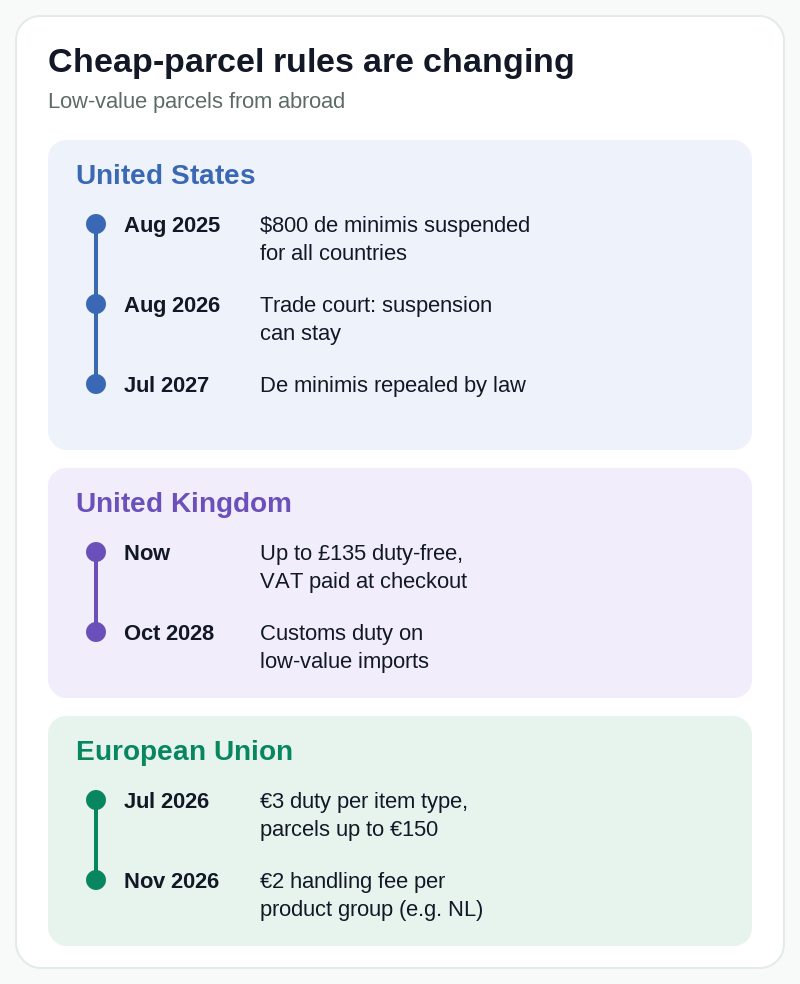
Prices went up. US duty-free de minimis is gone, the EU added a €3 duty per item type from July 2026, and the UK will end its £135 relief by October 2028.
Buy low-risk items only (no baby toys, chargers, cosmetics) and pay by credit card or PayPal.
Who are Temu, Shein, AliExpress and Alibaba?
All four are large, legal businesses, not fly-by-night stores. Most work as marketplaces: thousands of mostly Chinese sellers list products, and the platform handles checkout and shipping.
Temu is owned by PDD Holdings, the company behind China's huge Pinduoduo app. It sells almost everything at very low prices and has moved more fulfilment to local warehouses in the US and Europe (Supply Chain Dive).
Shein started as a fast-fashion brand and now also runs a marketplace for other sellers.
AliExpress belongs to Alibaba Group. It lets Chinese manufacturers and traders sell directly to consumers abroad.
Alibaba.com is the wholesale sibling: a B2B marketplace where businesses buy in bulk from factories, usually with minimum order quantities.
Other names you may see: Joom (founded in Latvia in 2016, mostly Asian sellers), Joybuy (JD.com's European store, launched in 2026 with EU warehouses and big brands) and Fruugo (a UK-based marketplace where sellers from many countries list products, often seen in Google Shopping).
Temu ships what you order and has workable refund processes. Its problem is what gets sold. On May 28, 2026 the European Commission fined Temu €200 million under the Digital Services Act for failing to properly assess the risk of illegal products on its platform (European Commission). In the Commission's mystery shopping, a very high share of chargers failed basic safety tests, and a high share of baby toys posed medium-to-high risks, from banned chemicals to choking hazards.
In the US, Temu agreed in September 2025 to pay a $2 million civil penalty over alleged violations of the INFORM Consumers Act, including not giving shoppers clear ways to report suspicious listings (FTC).
What works in Temu's favour:
Refunds for items that don't arrive or are damaged, handled in the app.
Returns: in the EU, its own policy gives 90 days with the first return per order free (Temu policy, updated June 2026). Return terms differ by country, so check your local version.
Card and PayPal payments, which give you a second line of defence.
Watch for the gamified app: spin-the-wheel prizes, countdowns and "almost free" offers are built to make you buy more than you planned.
Is Shein legit?
Shein is legit and ships reliably, but sits under the same scrutiny. On February 17, 2026 the European Commission opened formal proceedings against Shein under the Digital Services Act, covering illegal products and addictive design (European Commission). In 2025 France's data regulator CNIL fined Shein €150 million for placing cookies without consent (CNIL).
In the European product test described below, Shein reacted faster than Temu: it removed the flagged products and sent the buyer a recall notice.
AliExpress is legit and has the longest track record of buyer protection, but also got the biggest fine. On July 20, 2026 the European Commission fined it €550 million for failing to take effective measures against illegal, unsafe and counterfeit products (European Commission).
On AliExpress you buy from an individual store. The seller's rating, order count and how long the store has existed matter more than the AliExpress name. Brand-name goods at a fraction of the normal price are almost always counterfeit.
Yes, but it's a different product. Alibaba.com is for businesses sourcing stock from manufacturers, not for buying one phone case. You negotiate with suppliers, often order in hundreds, and arrange shipping and import yourself.
The risks are different too: fake "factories" that are really middlemen, samples that don't match the bulk order, and suppliers who ask you to pay outside the platform. Stick to Verified Suppliers, order samples first, pay only through Alibaba.com so your order falls under Trade Assurance, and never send a wire transfer to a bank account you got in a chat.
How safe are the products, really?
This is where the risk sits, and independent tests agree.
European consumer groups from Germany, France, Belgium and Denmark bought 162 products on Temu and Shein: necklaces, toys for under-3s and USB chargers. About 70% did not meet EU safety rules, a quarter were outright dangerous, and only 2 of 54 chargers fully complied. One necklace pendant was 85% cadmium, a carcinogen (Consumentenbond, October 2025).
The Dutch product safety authority (NVWA) found that 19 of 30 toys for under-3s bought on Temu, AliExpress, Wish and Shein broke safety rules, with loose parts, small balls and overly strong magnets (NL Times, November 2026).
BEUC, the European consumer organisation, reported similar problems in tests by members in Denmark, Italy and the UK, from cosmetics with wrong ingredient lists to "highly dangerous" electric heaters (BEUC).
Buy these somewhere else
Toys for babies and toddlers, chargers and anything that plugs into the wall, cosmetics and skincare, jewelry worn on skin, and safety gear such as bike helmets. A T-shirt, phone case or storage box is a far smaller risk.
What changed for US, UK and EU shoppers?
The cheap-parcel loopholes are closing everywhere, at different speeds.
United States
The $800 de minimis exemption, which let small parcels in duty-free, was suspended for China and Hong Kong in May 2025 and for all countries from August 29, 2025.
On February 20, 2026 the Supreme Court ruled that the IEEPA law can't be used to impose tariffs (Thomson Reuters). But in August 2026 the Court of International Trade ruled that the de minimis suspension itself can stay (Axios).
Congress has separately repealed de minimis by law, effective July 2027.
For you this means: duties apply to small imports, and they're usually built into the price or shown as "import charges" at checkout. Rates have changed several times, so compare the final total, not the item price.
United Kingdom
Goods up to £135 can still enter without customs duty, though VAT is charged at checkout.
On June 23, 2026 the government brought forward the end of that relief: from October 2028, low-value imports will face customs duty (GOV.UK).
European Union
VAT has applied to every import since July 2021.
Since July 1, 2026, parcels up to €150 pay a temporary €3 customs duty per item type (per tariff line, not per piece): five T-shirts cost €3, three T-shirts and a watch €6 (European Commission).
A €2 handling fee per product group applies on top, for example in the Netherlands since November 1, 2026 (Dutch government).
How cheap-parcel rules changed in the US, UK and EU.
Temu vs Shein vs AliExpress vs Alibaba compared
Temu
Shein
AliExpress
Alibaba.com
What it is
Marketplace (PDD Holdings)
Fashion brand + marketplace
Marketplace (Alibaba Group)
B2B wholesale marketplace
Who it's for
Consumers
Consumers
Consumers
Businesses
Ships from
China + local warehouses
Mostly China
China, some local warehouses
Factory, you arrange freight
Protection
Refunds in app; card/PayPal
Refunds in app; card/PayPal
Buyer protection; card/PayPal
Trade Assurance when paid on-site
Recent action
€200m EU fine, $2m FTC penalty
EU formal investigation, €150m CNIL fine
€550m EU fine
–
Main risk
Unsafe products
Unsafe products, privacy
Counterfeits, unsafe products
Fake suppliers, off-platform payment
Policies and payment options change often and differ by country. Always check the platform's own pages before you order.
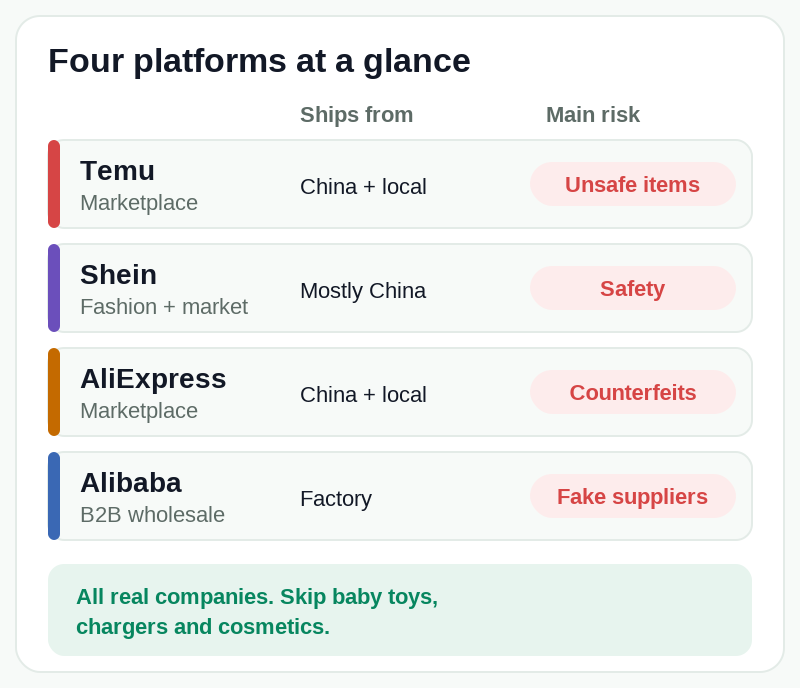
The four platforms at a glance.
What about your data?
These apps collect a lot. Several US states, including Kentucky and Arizona, have sued Temu over data collection; Temu denies the allegations (Fortune). Shein's CNIL fine was about tracking cookies without consent.
Simple steps: shop in the browser instead of the app if you can, deny the app access to contacts, location and photos, reject tracking cookies, and use a separate email address. Ignore texts and emails "from Temu" offering free gifts or saying a parcel is stuck; those are usually phishing. See how to spot phishing.
How do you buy safely from Temu, Shein or AliExpress?
Use the official app or type the address yourself. Look-alike scam sites exist. If you're unsure, run through how to tell if a website is legit.
Priya orders five storage bins and a bike light from Temu for $21. The bins are fine. The light dies after a week; she requests a refund in the app and has the money back within days.
Her neighbour Dan buys a teething toy for his 10-month-old and a fast charger. Beads come loose from the toy and the charger gets hot. Those are exactly the categories regulators keep flagging. A store that has to answer to safety rules would have been the better choice.
What if your order never arrives or is dangerous?
Start with the platform. All of them have "not received" and "not as described" processes.
Not delivered? Wait out the estimated delivery window, check tracking, then file a claim in the app. More in package not delivered.
Platform won't help? Open a PayPal dispute or a card chargeback.
Dangerous product? Stop using it, report it to the platform and to your safety regulator: the CPSC in the US, your local Trading Standards via Citizens Advice in the UK, or the national authority in your EU country. If you were scammed by a fake store, follow scammed online: how to get your money back.
Share what happened
Had a good or bad experience with one of these platforms? Write a review, or see what others report on the Temu profile.
Your next step
Order the phone case or storage box if the price is right, but buy anything a child puts in their mouth or that plugs into the wall from a seller bound by your country's safety rules. Found an unfamiliar "factory direct" store through an ad? Check it free at /reputation before you pay.
Frequently asked questions
No. Temu is run by PDD Holdings, a company listed on Nasdaq, and most orders are delivered. Its problems are product safety and aggressive sales tactics, not taking money without shipping. Be careful with fake Temu sites and texts promising free gifts, which are phishing.
Shein is a real company and ships what you order, usually cheap fashion. Safety tests by European consumer groups found many non-compliant products on Shein and Temu, and the EU opened a formal investigation into Shein in February 2026. Clothes are a low risk; avoid children's jewelry, cosmetics and electrical items.
Yes. AliExpress is owned by Alibaba Group and has buyer protection with refunds for items that don't arrive or don't match the listing. Quality depends on the individual seller. In July 2026 the EU fined AliExpress €550 million for not doing enough against illegal and counterfeit products, so check seller ratings carefully.
Alibaba.com is a legitimate wholesale (B2B) marketplace for businesses buying in bulk from manufacturers. It's not built for single consumer orders. Fake or unreliable suppliers do exist, so use Verified Suppliers, pay through Alibaba.com with Trade Assurance and never wire money off the platform.
Yes. The $800 de minimis duty-free exemption has been suspended for all countries since August 29, 2025, and a federal trade court ruled in August 2026 that the suspension can stay. Duties are usually included in the price or shown at checkout. Congress has also repealed de minimis by law from July 2027.
Usually yes. Temu offers refunds for items that don't arrive or are faulty, and in the EU its policy gives 90 days to return with the first return per order free. Pay by credit card or PayPal so you can dispute the charge if the platform doesn't help.
Is this website trustworthy?
Check any webshop for free: company details, reviews, payment safety and warning signs.
Read next
Scams and fake shops12 min read
Is This Website Legit? 18 Checks to Spot a Scam Site in 2 Minutes
To tell if a website is legit, check who owns it (company registry), how old the domain is, whether Google flags it, what other people say, and whether you can pay with buyer protection. Here are 18 signals and a 2-minute routine you can run before every purchase.
Paying safely11 min read
Safest Way to Pay Online: Every Method Ranked by Protection
The safest way to pay online is a credit card, followed by PayPal (Goods and Services): both let you claw your money back if a seller doesn't deliver. Debit cards and buy now, pay later are middling. Bank transfers, Zelle, wires, crypto and gift cards offer almost no protection.
Reading reviews12 min read
How to Spot Fake Reviews: 12 Signs and a 5-Minute Method
You spot fake reviews by their pattern: a rating split with almost only 5 stars, sudden bursts, vague praise and reviewers with no history. Here are 12 signs, a 5-minute reading method for Amazon, Google and Trustpilot, and what the new US and UK bans mean for you.