Package Not Delivered but Says Delivered? What to Do Next
If tracking says delivered but you have no package, search nearby, wait up to 48 hours, then contact the seller, not just the carrier. The seller can replace or refund, and your card or PayPal is the backup. Here are the exact steps for USPS, UPS, FedEx, Amazon, Royal Mail and Evri.
FeedbackPlatform editorial teamNovember 25, 2026 10 min read
If your tracking says delivered but there's no package, search nearby and give it up to 48 hours. Then contact the seller you bought from, not only the carrier. The seller has the contract with the carrier, can file the claim, and is the one who can replace or refund. Your credit card or PayPal is the safety net if the seller won't help.
In short
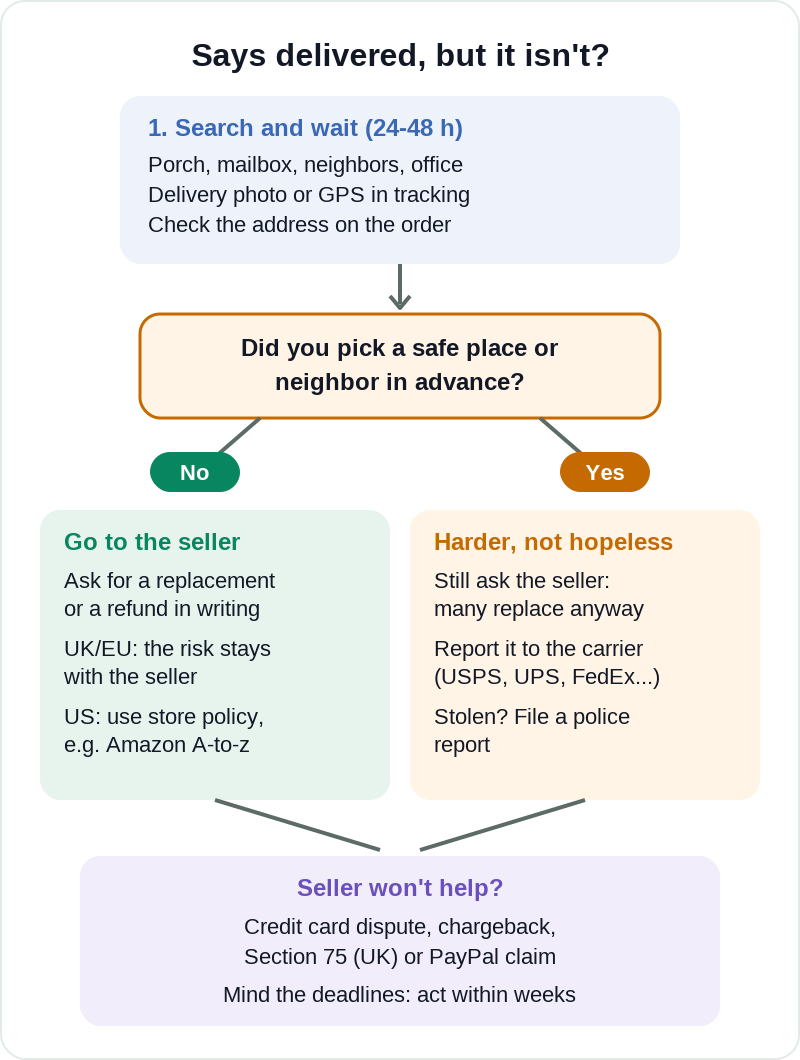
Day 1: check porch, mailbox, parcel lockers, neighbors and building office. Look at the delivery photo or GPS details in the tracking app.
Within 48 hours: packages are sometimes scanned as delivered early. If it doesn't show up, contact the seller in writing.
USPS: use the "Where is my package?" form; a Missing Mail search is possible 7 days after mailing; report theft to the Postal Inspection Service.
UK and EU: the retailer carries the risk until you receive the goods, so it must replace or refund unless you chose a safe place or neighbor.
Seller won't help? Dispute the charge with your card (60 days from the bill in the US), use Section 75 or chargeback in the UK, or open a PayPal case.
What should you do when a package says delivered but isn't there?
Search first, then go to the seller. Most "delivered but missing" packages turn up within a day or two, and the rest are solved faster by the seller than by the carrier.
Search the obvious and not-so-obvious places: porch, back door, side gate, garage, mailbox, community parcel lockers, the leasing office, the neighbors on both sides.
Open the tracking details, not just the headline status. Look for "In/At Mailbox", "Front Door", "Parcel Locker" or "Left with Individual", plus any delivery photo.
Check your shipping address in the order confirmation. A wrong apartment number is a classic.
Ask your household. Someone may have brought it in.
Wait 24 to 48 hours.Amazon advises allowing 48 hours, because packages are sometimes scanned as delivered before they arrive.
Contact the seller in writing with your order number and what you've checked.
Report it to the carrier so it can talk to the driver and check GPS data.
If it was stolen, file a police report and keep the report number.
The key question: did you pick a safe place or neighbor in advance?
Who is responsible for a lost or stolen package?
It depends on where you live. In the UK and EU, the law puts the risk on the seller until you have the goods. In the US, the seller's terms decide, but retailer policies and card rights usually still get you your money back.
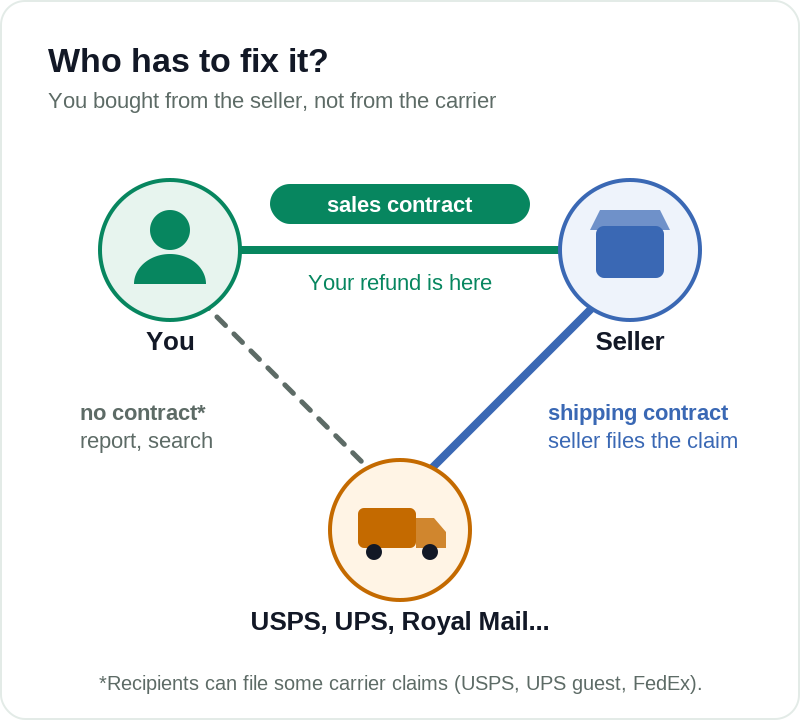
Your contract is with the seller. The carrier claim is the seller's job.
United States: read the terms, then use the policy
There's no single federal rule on who carries the risk for an online order. Under state law based on the Uniform Commercial Code, the contract terms matter. Many big retailers spell it out. Amazon's Conditions of Use say purchases "are made pursuant to a shipment contract", meaning "the risk of loss and title for such items pass to you upon our delivery to the carrier."
That sounds bad, but in practice:
Most retailers replace or refund a missing package at least once, because a happy customer is worth more than a $40 item.
Marketplaces add their own guarantees, such as the Amazon A-to-z Guarantee.
The Fair Credit Billing Act lets you dispute credit card charges for things that "weren't delivered as agreed."
United Kingdom: the retailer carries the risk
Section 29 of the Consumer Rights Act 2015 is clear: goods "remain at the trader's risk until they come into the physical possession of" you or someone you identified to receive them. The only exception is a courier you hired yourself that the trader didn't offer.
So if Royal Mail, Evri, DPD or Yodel lost your parcel, the retailer must sort it out. Which? adds a catch: if you nominated a safe place or a neighbor, you'll generally be treated as having received the delivery once it's left there.
European Union: same principle
EU consumer law also keeps the risk with the seller until you, or someone you named, takes physical possession. If you live in the EU and buy from a shop in another EU country, the European Consumer Centre in your country can help for free.
Don't let the retailer send you to the courier
"Please contact the carrier" is a standard script. But carriers like UPS and DHL point recipients back to the shipper, because the shipper holds the contract and files the claim. Reply politely that delivery is the retailer's responsibility and ask for a replacement or refund.
How do you report a missing USPS package?
USPS has several routes, depending on what happened.
Delivered but not received, or stolen: USPS's Mail Theft FAQ says to use the "Where is my package?" form for packages with a tracking number. Your local Post Office can also talk to the carrier on your route.
Never arrived, no delivery scan: submit a Missing Mail search at MissingMail.USPS.com. You can do this starting 7 days after the mailing date. Customer Care can't file it for you.
Mail theft: report it to the U.S. Postal Inspection Service at 1-877-876-2455, and file a police report too.
Insurance claim: either the sender or the recipient can file, according to USPS claims, but you need the original mailing receipt. For lost Priority Mail, the window opens 15 days after mailing and closes 60 days after.
In practice, the seller usually has the receipt, the insurance and the incentive. Let them file while you push for a replacement.
UPS, FedEx and Amazon: what are the rules?
Each carrier and marketplace has its own process. This table sums up what they say on their own help pages.
Carrier or store
Who can claim
Key deadline
Watch out for
USPS
Sender or recipient, with mailing receipt
Missing Mail search from 7 days after mailing; Priority Mail claims 15 to 60 days after mailing
Use "Where is my package?" for delivered-but-missing items
Contact the retailer first: you usually get a better result
Evri, DPD, Yodel
Usually the sender
Varies by courier
Your rights are with the retailer under the Consumer Rights Act
Amazon package says delivered but not received
Follow Amazon's own checklist: check the address, the delivery photo, neighbors, and wait 48 hours. Then contact Amazon (for items sold by Amazon) or the third-party seller through Your Orders.
For third-party sellers, the A-to-z Guarantee applies. You can file once 3 days have passed since the latest estimated delivery date, or once tracking shows delivered, if you contacted the seller more than 48 hours earlier without a fix. The last possible delivery date must be within 90 days. Don't file a chargeback at the same time: Amazon says that makes you ineligible.
UPS package says delivered but not received
UPS's claims page has an important line: packages released to your address without a signature aren't eligible for lost claims. That's another reason to go straight to the seller. Recipients can still report it as a guest, and the seller can ask UPS to investigate with the driver.
FedEx package says delivered but not received
FedEx lets recipients contact the merchant for a replacement, ask the merchant to file, or file a claim themselves. Lost-shipment claims have a long window of 9 months from the ship date, but don't wait: the sooner FedEx checks the driver's GPS, the better.
Missing headphones on a Tuesday
Maria in Texas orders $129 headphones from an electronics store. USPS tracking says "Delivered, In/At Mailbox" on Tuesday at 2:14 pm, but her mailbox is empty. She checks with her neighbors and the apartment office, then waits until Thursday morning. Nothing. She emails the store with her order number, a screenshot of the tracking and a note that she hadn't authorized any safe place. She also submits USPS's "Where is my package?" form. The store replies that it will file a claim with USPS and ships a replacement. Had the store refused, Maria paid by credit card: her next step would have been a dispute with her card issuer for goods not delivered, well within the 60-day window.
How do you get your money back if the seller won't help?
Go to whoever handled your payment. These protections exist exactly for this situation.
Credit card (US): dispute the charge under the Fair Credit Billing Act. Your letter must reach the issuer within 60 days after the first bill with the charge was sent.
Credit card (UK): if the item cost more than £100 and up to £30,000, Section 75 of the Consumer Credit Act makes your card company equally liable.
Debit card or smaller credit card purchases: ask for a chargeback. It isn't a legal right but part of card scheme rules, and Which? says claims are typically due within 120 days, often counted from the expected delivery date.
PayPal: open an "item not received" case within 180 days of payment.
Buy now, pay later (Klarna, Afterpay, Affirm): report the problem in the app. Many providers can pause payments while a dispute is open.
Bank transfers, Zelle, wire transfers, gift cards and crypto give you almost none of this protection. Read the safest way to pay online before your next big order.
If the store never shipped anything and has gone quiet, you may be dealing with a fake shop rather than a lost package. Follow the steps in scammed online: how to get your money back, and next time check the site first:
Is this website trustworthy?
Check any webshop for free: company details, reviews, payment safety and warning signs.
How do you spot a fake "missed delivery" text?
When you're waiting for a package, you're the perfect target. Scammers send texts like "USPS: your package could not be delivered, update your address" or "Royal Mail: pay £1.45 to reschedule."
The link goes to a lookalike domain, not usps.com or royalmail.com.
You're asked to pay a small fee or enter card details.
There's pressure: "within 24 hours or the package returns to sender."
Don't click. Check the status in the official app or through the seller's email. Citizens Advice warns that texts asking you to pay to release a parcel are usually scams. More examples in how to spot phishing.
Checklist for a missing package
Screenshot the tracking page, including time and delivery photo
Search porch, mailbox, lockers, neighbors and office
Confirm the shipping address on the order
Wait up to 48 hours
Email the seller with order number, screenshots and what you checked
Report it to the carrier (USPS form, UPS or FedEx claim)
Stolen? File a police report
No solution? Dispute with your card, PayPal or BNPL provider before the deadline
Your next step
Send the seller a short written message today, with your order number and a screenshot of the tracking. It's the step people skip most and the one that solves most cases. If you want to avoid this next time, pick a pickup point, locker or "signature required" delivery for anything valuable. And if you also want to know your rights for returns and faulty items, read online shopping rights: returns and refunds.
Frequently asked questions
Common reasons: the carrier scanned it early, left it in a parcel locker or with a neighbor, delivered to the wrong address, or the package was stolen after delivery. Packages are sometimes scanned as delivered before they actually arrive, which is why Amazon advises allowing 48 hours. If it still hasn't shown up, contact the seller and use USPS's 'Where is my package?' form.
In the UK and EU, the seller is responsible until the goods are in your hands or with someone you nominated. In the US it depends on the seller's terms: Amazon, for example, says risk passes when it hands items to the carrier. In practice most US retailers still replace or refund, and your card dispute rights remain.
Yes. USPS lets either the sender or the recipient file a claim for an insured package, but you need the original mailing receipt, which usually only the sender has. For a lost Priority Mail package, the claim window opens 15 days after mailing and closes 60 days after. Asking the seller to file is often easier.
Yes, if you believe the package was stolen. A police report won't get you a refund on its own, but it strengthens your claim with the retailer, your card issuer and the carrier. For mail theft from USPS, you can also report to the U.S. Postal Inspection Service at 1-877-876-2455.
Under the Fair Credit Billing Act, your written dispute must reach your credit card issuer within 60 days after the first bill with the charge was sent to you. Card scheme chargebacks often run to about 120 days from the expected delivery date. PayPal gives you 180 days. Don't wait for the deadline: start once the seller stops helping.
In the UK and EU, no: the retailer must show the goods actually reached you or the place you agreed to. In the US it depends on the store's policy. Many retailers still replace items once, and if they refuse, a credit card dispute for goods 'not delivered as agreed' is your strongest route.
Is this website trustworthy?
Check any webshop for free: company details, reviews, payment safety and warning signs.
Read next
Your rights10 min read
Online Shopping Rights: Returns, Refunds and the 14-Day Rule
In the EU and UK you can cancel most online purchases within 14 days of delivery and get a refund within 14 days, plus a legal guarantee for faulty goods. In the US there is no federal right to return: the store's policy, state law and your card's dispute rights decide.
Scams and fake shops12 min read
Is This Website Legit? 18 Checks to Spot a Scam Site in 2 Minutes
To tell if a website is legit, check who owns it (company registry), how old the domain is, whether Google flags it, what other people say, and whether you can pay with buyer protection. Here are 18 signals and a 2-minute routine you can run before every purchase.
Paying safely11 min read
Safest Way to Pay Online: Every Method Ranked by Protection
The safest way to pay online is a credit card, followed by PayPal (Goods and Services): both let you claw your money back if a seller doesn't deliver. Debit cards and buy now, pay later are middling. Bank transfers, Zelle, wires, crypto and gift cards offer almost no protection.